Aged care rights & agreements
Aged Care Service Agreement Transition: The 1 November 2026 Deadline for Residential Aged Care Providers
Under the Aged Care Act 2024, the old resident agreement was replaced by a new, more detailed service agreement on 1 November 2025. Providers now have a hard transition deadline: every resident who entered care before that date under a previous agreement — and every permanent resident who never signed one at all — must be moved onto a compliant service agreement before 1 November 2026. Seven weeks out, the Aged Care Quality and Safety Commission has already announced it is investigating a provider for failing to meet consultation and service agreement requirements. This guide covers who is affected, what the new agreement must contain, what happens if a resident refuses, and a 30-day transition plan that lands before the deadline.
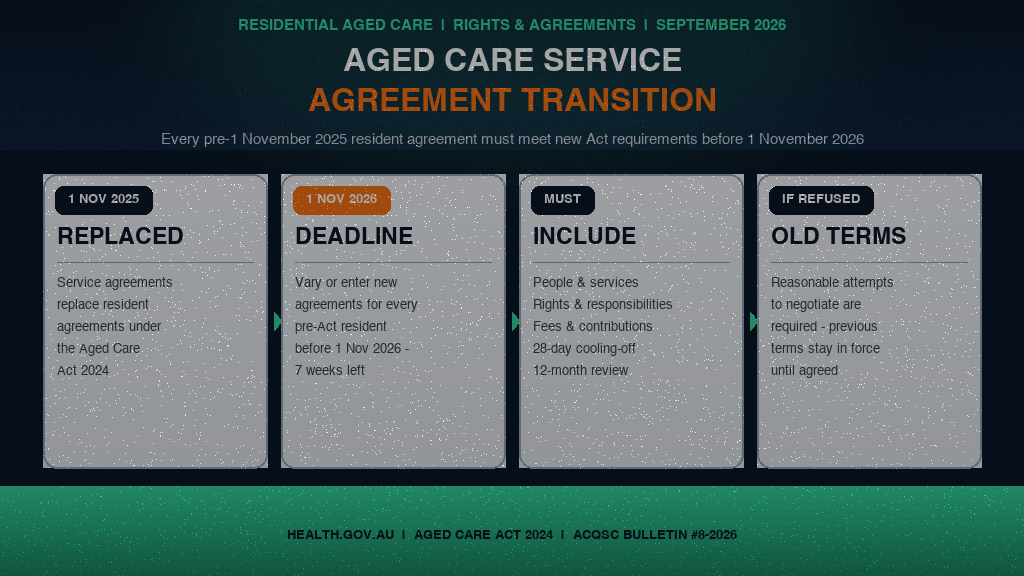
From 1 November 2025, the Aged Care Act 2024 replaced the decades-old resident agreement with a new, far more detailed service agreement — and gave providers one year to move every existing resident across. That year runs out on 1 November 2026. Any resident who entered a residential aged care home before 1 November 2025 under an old-format agreement must have that agreement reviewed and varied, or replaced outright, to meet the new requirements before the deadline. Permanent residents who never signed any agreement must get one too. With roughly seven weeks left, this is a transition that cannot be done in the last week of October without risk — and the regulator has already signalled it is watching.
Background: from resident agreements to service agreements
Under the old Aged Care Act 1997, providers and residents entered into a resident agreement covering accommodation and care arrangements. The regime was familiar, but it was built for a different era: agreements varied widely in what they covered, fee-setting practices were opaque, and older people had limited leverage to negotiate. The Royal Commission into Aged Care Quality and Safety identified the agreement framework as one of the places where residents' rights were weakest in practice.
The new Act rewrote that framework. From 1 November 2025, a service agreement is the single legal agreement between a registered provider and a resident: it records the resident's right to occupy a bed, the standard level of care and services the provider will deliver, and what those services cost. The Aged Care Quality and Safety Commission's glossary describes the service agreement as a written agreement between a registered provider and an individual accessing funded aged care services, setting out the services the provider will deliver in accordance with the requirements prescribed in the Aged Care Rules 2025 — and it makes the point explicitly that making a service agreement is a negotiation between the individual and their provider, not a take-it-or-leave-it form.
Two other agreements sit alongside it, and it is worth keeping them separate: an accommodation agreement for the resident's accommodation arrangements (a permanent-care resident needs both), and a Higher Everyday Living Fee (HELF) agreement where a resident chooses additional services of a higher standard than those on the residential care service list. The HELF transition has its own, parallel deadline — legacy extra and additional service fee arrangements end on 31 October 2026 — covered separately in our HELF transition guide.
What changed and when: the new agreement requirements and the 1 November 2026 transition
The mechanics of the transition, as set out by the Department of Health, Disability and Ageing:
- New residents from 1 November 2025. A service agreement must be agreed before, or on, the day the resident enters the home. It must be in plain language, include the mandatory content below, and a copy must be provided to the resident. An agreement can be entered into verbally in some cases, but providers must record their interactions and the resident's agreement as part of their record-keeping responsibilities.
- Residents with a pre-1 November 2025 resident agreement. The provider must review and vary the existing agreement — or enter into a new one — so it meets the new service agreement requirements, before 1 November 2026.
- Permanent residents with no existing agreement. They must enter into a service agreement before 1 November 2026, consistent with the arrangements that have been in place between provider and resident before the start of the Act. There is no exemption for "it has always been informal".
- Short-term residents without an agreement. The one carve-out: short-term residents who did not have a resident agreement as of 1 November 2025 are not required to enter a new service agreement.
- Residents who do not agree. Providers must demonstrate reasonable attempts to negotiate and reach a mutual agreement. Until a new service agreement is established, the terms of the previous resident agreement remain in effect.
The mandatory content falls into three buckets, per the Department's guidance:
- People and services — resident details (name, contact, registered supporters or guardians), provider details, the home's name, address and contact details, a copy of the resident's access approval, the agreement's commencement date, the resident's start date, the standard level of care and services to be provided, and — for residential respite — when services cease and the end date.
- Rights and responsibilities — a copy of the Aged Care Statement of Rights, a copy of the Aged Care Code of Conduct, the resident's right to occupy a bed, how and when the agreement may be terminated (including the circumstances in which the resident may be asked to leave, and the assistance the provider will give to find suitable alternative accommodation), the complaints and feedback management system, the resident's rights and responsibilities, the provider's rights and responsibilities, and any individual matters agreed between the parties.
- Fees and contributions — which fees and contributions the resident may be asked to pay, a copy of the provider's policies and practices for setting and updating fee and contribution amounts, how interest will be calculated on late payments, and what happens if the resident does not pay.
Two protections run through every agreement. First, the 28-day withdrawal period: a resident can withdraw from the agreement within 28 days of agreeing — verbally or in writing — and the agreement has no effect. The resident remains liable for fees for care actually delivered in that period, and every other amount paid must be refunded. Second, the 12-month review cycle: agreements must be reviewed every 12 months, and updated whenever a resident's care needs change or they ask — with a copy of the updated agreement provided as soon as possible after finalising it.
The transition is not happening in a vacuum. In its Aged Care Quality Bulletin #8-2026, published this month, the Commission announced it is investigating a Support at Home provider that "did not comply with consultation and service agreement requirements" and included care management costs in its service delivery prices — with refunds and further enforcement action flagged, and civil penalties available under the Act where providers fail to cooperate with investigators. The same bulletin lists "aged care rights in practice" as one of the Commission's four sector risk priorities for 2026-27. The message for residential providers is direct: agreement compliance is an enforcement priority, not an administrative formality.
Operational impact: six things every residential provider should do now
The transition is a cohort-by-cohort exercise, and the cohort register is the foundation. Six actions for every residential aged care provider between now and 1 November:
- Audit every resident into one of three cohorts. (1) Pre-1 November 2025 resident agreement in place — needs review and variation or replacement; (2) permanent resident with no agreement at all — needs a new service agreement consistent with long-standing arrangements; (3) short-term residents without an agreement as at 1 November 2025 — exempt, but you need the evidence to prove the exemption applies. Every resident must be classified, and the classification recorded, before the work can be scheduled.
- Run a mandatory-content gap analysis on every template. Compare your current agreement template against the three buckets — people and services, rights and responsibilities, fees and contributions — and against the 28-day withdrawal and plain-language requirements. A template that is missing the Statement of Rights, the Code of Conduct, the termination-and-rehousing clause or the fee-setting policy is non-compliant however many residents sign it.
- Plan the no-worse-off and grandfathering conversation per resident. Transitioning residents who entered under the old Act carries a no-worse-off principle: residents should not end up with weaker rights or higher charges than their previous arrangements provided. Work out per resident what actually changes between their old agreement and the new one — not what the template says, but what each individual's terms say — before the conversation starts.
- Build the refusal workflow now. Residents who do not agree must be met with documented reasonable attempts to negotiate, and the previous agreement's terms remain in force meanwhile. That means a record of each conversation, the matters offered, and the resident's response — evidence you may need to show the Commission that the transition is stalled despite good-faith effort, rather than ignored. Disputes should be escalated early, including to the resident's registered supporters, guardian or an advocate (such as OPAN), not parked until October.
- Get the fees documentation in order. Fee and contribution policies are now mandatory agreement content, and pricing transparency is the compliance issue the Commission's prudential review program keeps finding. The agreements must attach the provider's actual policies for setting and updating fees, late-payment interest, and non-payment consequences — policies that have to exist and be current before they can be attached to hundreds of agreements.
- Coordinate with the rest of the October-November deadline season. The agreement transition lands in the same quarter as the first externally audited Care Minutes Performance Statement (due with the 2025-26 ACFR on 31 October 2026), the end of legacy extra and additional service fee arrangements (31 October 2026), and the online cost-of-care information requirements (30 November 2026). Staff who can run resident conversations are also the staff who assemble reporting evidence — schedule the agreement campaign before October absorbs everyone.
A 30-day transition workflow: from mid-September to the deadline
Seven weeks is enough — if the work starts now. This 30-day plan lands a complete, evidenced transition before 1 November:
- Days 1-5 — Cohort register and template gap analysis. Classify every resident into the three cohorts above, pull every current agreement from the file, and compare the template against the mandatory content buckets. Flag the residents with no agreement, residents whose old agreements are decades old, and residents with registered supporters or guardians who need to be part of the process. Produce one register: resident, cohort, current agreement status, required action.
- Days 6-12 — New template, fee policies and legal review. Draft the service agreement template with the legal team, attach the current Statement of Rights and Code of Conduct, and confirm the fee and contribution policies that will be attached to it. Test the 28-day withdrawal clause and the termination and rehousing clause against your actual practices — an agreement that promises assistance your home does not deliver is a contract risk, not a compliance win. Print plain-language versions; arrange translation or interpreter support (including the National Translating and Interpreting Service) where residents need it.
- Days 13-19 — Resident conversations, cohort by cohort. Run the negotiated discussions: start with permanent residents who have no agreement at all, then residents whose existing agreements are furthest from the new requirements. Explain what changes and what does not, confirm the no-worse-off position, and record every interaction. Where a resident needs time, book the follow-up before the end of October — the 28-day cooling-off period applies to new agreements, so signatures cannot all happen on 31 October.
- Days 20-26 — Sign, vary, file. Execute the varied or new agreements, provide copies, and file the originals with the resident's care records. Where a resident refuses, log the reasonable-attempts record and keep the previous agreement's terms in force — flagged for escalation and follow-up, not closed. Update the register to show each resident's new status.
- Days 27-31 — QA and hand over to the review cycle. Audit the register against the resident list: every resident either transitioned, exempt with evidence, or refusal-documented with reasonable attempts on file. Confirm every resident received a copy, and set the 12-month review calendar so the next review is an event on the schedule, not a rediscovery. Give the board and the quality team one evidence pack: the register, the template, the policies, and the refusal records.
How NovoCove supports this
A service agreement transition is, underneath the legal work, an evidence exercise: which residents hold which agreements, what standard of care and services the agreements promise, which credentialed staff deliver them, and what records exist when the Commission asks. NovoCove is the data and evidence layer behind that exercise — it centralises staff certifications and training expiry for aged care providers, including AHPRA registration for registered and enrolled nurses, NDIS Worker Screening, first aid and training credentials across every site, with automatic alerts from expiry windows and a RAG status per service. When an agreement says a resident will receive care from a particular standard of workforce, NovoCove is where the proof that the workforce is current, registered and credentialed actually lives — and it can be exported the moment a regulator, an auditor or a resident's supporter asks.
Audit logging and Daily ComplianceSnapshot trend give the transition itself a defensible record: the cohort register, the negotiation timeline, the review dates and the evidence packs can be organised and produced as one export rather than reconstructed from email chains. The same discipline carries into the rest of the deadline season — the CMPS audit evidence, the HELF transition and the cost-of-care publication all rest on the same current workforce and evidence register.
NovoCove does not draft agreements, give legal advice, or negotiate with residents: service agreements are negotiated legal documents between a provider and each resident, and content, pricing, no-worse-off positions and refusal strategy stay with your legal and care teams. It does not replace your document management system or legal counsel. What it does is keep the workforce and evidence layer those agreements sit on current — the same data any provider needs to answer "who was eligible, on which shift, with which current registration, on the day this agreement's service promise was made". The coverage is detailed on the aged care compliance software page.
Book a 20-minute demo and we will show you what a residential workforce register looks like when every AHPRA registration and training expiry has an owner and an alert cadence — before the 1 November agreement deadline and the reporting season land together.
Sources / further reading
- Service agreements for residential aged care — Department of Health, Disability and Ageing (T1)
- Aged Care Quality Bulletin #8-2026 — Aged Care Quality and Safety Commission (T1)
- ACQSC Glossary: service agreement definition — Aged Care Quality and Safety Commission (T1)
- Aged Care Act 2024 (C2024A00104) — Federal Register of Legislation (T1)
- Aged Care Rules 2025 (F2025L01173) — Federal Register of Legislation (T1)
- Understanding the no-worse-off principle and grandfathering rules — Russell Kennedy (T3)
- Replacement aged-care service agreements in 2026: what to check before signing — Curalune (T3)
This guide is general information and is not legal advice.