Aged care compliance
ACQSC RB 2026/1 Support at Home Pricing Compliance: Service Agreements, Monthly Statements and the Reasonable-Price Test Every Provider Must Pass
On 30 June 2026 the Aged Care Quality and Safety Commission published version 2.0 of Regulatory Bulletin RB 2026/1 — Support at Home pricing requirements. The bulletin updates the rules on unit pricing, service agreements, monthly statements, individualised budgets and the reasonable-price test under sections 148-70, 155-80, 166-1005 and 273-15 of the Aged Care Rules 2025. Here is what changed in version 2.0, what the regulator can now compel, and the 30-day workflow every Support at Home registered provider should be running.
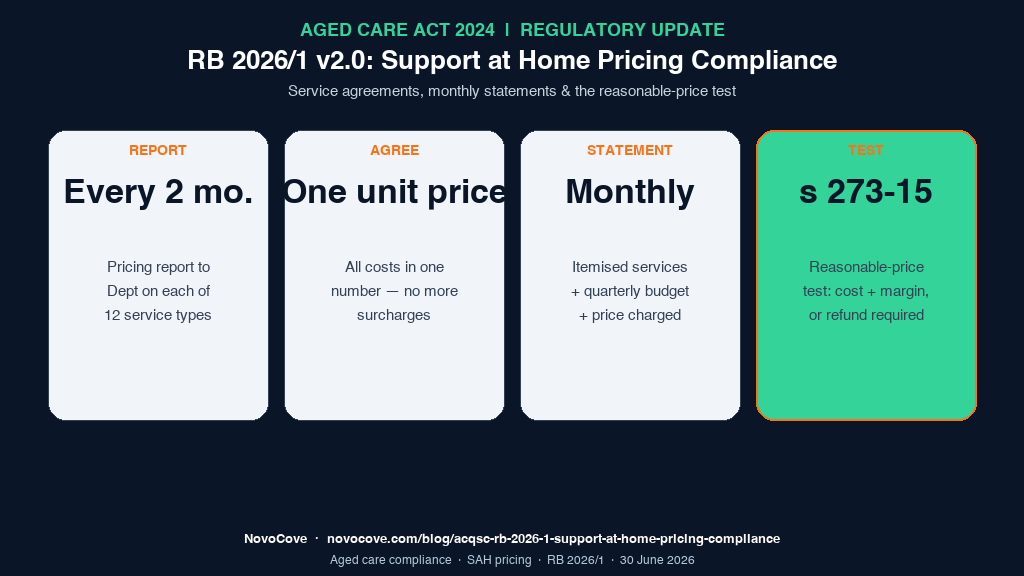
On 30 June 2026 the Aged Care Quality and Safety Commission published version 2.0 of Regulatory Bulletin RB 2026/1 — Support at Home pricing requirements. The bulletin is the operational rule book for every registered provider delivering funded aged care services through the Support at Home (SAH) program. Version 2.0 supersedes the original bulletin published on 23 January 2026, and it was promoted this week in Aged Care Quality Bulletin #6-2026 as the live compliance reference for pricing, service agreements, monthly statements, individualised budgets and the reasonable-price test. Here is what the version 2.0 update actually changes, what the Commission can now compel providers to do, and the 30-day workflow every SAH registered provider should be running.
What version 2.0 of RB 2026/1 actually says — the four operative changes
The bulletin's long title is dense, but the operative changes sit in four distinct places. Each one is a discrete update to the version 1.0 bulletin, and each one creates a compliance obligation that SAH providers can prepare for in advance.
- One unit price — no more add-on fees or surcharges. Providers must include all costs of delivering SAH direct services in one unit price. Package management, travel, and every other cost of providing the service must be in the unit price. Providers can no longer charge additional fees or surcharges separately. The unit price is the price that appears in the service agreement and the price that is published on the provider's website.
- Service agreement must be set up before the service starts, with the older person involved. The Aged Care Rules require a service agreement to be in place before funded aged care services are delivered. Version 2.0 clarifies that the agreement must be in plain language, must involve the older person in negotiating and developing it, must give the older person enough time to read and ask questions, and must explain the key parts (including how the provider decided on its prices). Where a price is higher than the price the provider publishes on its website, the agreement must explain and justify the difference (section 148-70(4)(c)).
- Monthly statement is now a hard obligation — no exceptions. Providers must give the older person a monthly statement that includes the current quarterly budget, an itemised list of services delivered during the month, and the amount charged for each service. Providers must help the older person to understand the statement. If the provider's business management software cannot issue monthly statements in the short term, the provider must try other ways to comply — but the obligation stands.
- Reasonable-price test under section 273-15 — the Commission can require a price change or a refund. An unreasonable price is a price that the provider cannot justify based on the cost of delivering the service plus a reasonable margin. Where the Commission forms the view that a price is unreasonable, the Commission can require the provider to change the price, require the provider to charge no more than a determined price, and require the provider to refund overcharged fees.
Each of these four changes is independently significant. The unit-pricing rule removes the most common surcharge workarounds. The service-agreement rule tightens the consent and disclosure test. The monthly-statement rule creates a continuous evidence trail that the regulator can audit on demand. The reasonable-price rule gives the Commission a direct price-control power. The combined effect is the most concrete compliance update since the SAH program commenced on 1 November 2025.
Why version 2.0 matters now — the timing pressure on providers
The version 2.0 bulletin was published on 30 June 2026, in the final days of the financial year, and was promoted this week in Aged Care Quality Bulletin #6-2026. Bulletin #6 explicitly names RB 2026/1 as the live reference for SAH pricing and confirms the Commission will use the bulletin's case study to assess compliance. The bulletin also confirms that providers cannot charge HELF for services that are required under the Aged Care Quality Standards and Statement of Rights — a finding that applies in parallel to RB 2026/1 for any provider delivering both residential and SAH services.
The Commission has signalled that pricing compliance is a live workstream. Bulletin #6 confirms the Commission is investigating several residential providers over HELF overcharging, that formal notices compelling information have been issued, and that providers who have already acknowledged errors and refunded residents are well placed. RB 2026/1 v2.0 is the same compliance signal for SAH providers. The obligation to publish unit prices, set up plain-language service agreements, issue monthly statements, and be ready to defend every price on the cost of delivery is now operational, not aspirational.
The unit-pricing rule — what the version 2.0 update actually says
The version 2.0 bulletin restates and tightens the unit-pricing rule. Under the rule, a provider must include every cost of delivering an SAH direct service in one unit price. The unit price must include labour (including sub-contracting costs), administration overheads, package management, travel, and a reasonable margin to cover the cost of capital used in delivering the service. The unit price can also include transition costs — costs that are direct and time-limited to changing the service model to meet the new SAH program — but normal business costs (such as managing the older person's care or funding) are not transition costs and cannot be charged separately.
Care management services are funded separately from other services. The bulletin restates that care management is funded through a 10% deduction from the older person's quarterly budget, and providers must not include care management activities in the cost of other care and services. Providers who have historically bundled care management into the unit price of other services will need to unbundle the activity, reprice the unit, and update both the service agreement and the monthly statement.
The service-agreement rule — what the version 2.0 update actually says
The version 2.0 bulletin sets out the minimum content of a service agreement, the process the provider must follow to develop the agreement with the older person, and the obligation on the provider to explain and justify any difference between the price in the agreement and the price the provider publishes on its website. The agreement must include the prices the provider will charge, the services the provider will deliver, when and how the agreement can be varied or reviewed, when the provider can stop delivering services to the older person, the reasons why the price is higher than the published price (if it is), and a plain-language summary the older person can understand.
The process obligation is just as important as the content obligation. The provider must involve the older person in negotiating and developing the agreement. The provider must explain the key parts of the agreement, including how it decided on its prices. The agreement must be in plain language and the older person must be able to understand it. The provider must give the older person enough time to think about the agreement and ask questions before signing. The version 2.0 bulletin includes a case study — "Ms Nguyen" — that walks through the agreement process step by step, and the case study is the standard the Commission will use when it reviews a provider's service-agreement workflow.
The monthly-statement rule — what the version 2.0 update actually says
The version 2.0 bulletin restates the monthly-statement obligation in detail. The monthly statement must include the older person's current quarterly budget, an itemised list of the services or items the provider delivered during the month, and the amount the provider charged for those services and items. The statement must be in plain language and the provider must help the older person to understand it.
The bulletin also addresses the operational reality that some providers' business management software cannot issue monthly statements in the short term. The bulletin is clear: if the software cannot issue statements, the provider must try other ways to comply. There is no exception to the monthly-statement obligation. The Commission can ask a provider for the content of monthly statements when it is checking pricing compliance or handling a complaint, and the absence of a monthly statement is itself a compliance breach.
The reasonable-price test — what the Commission can now compel
The reasonable-price test sits under section 273-15 of the Aged Care Rules 2025. An unreasonable price is a price that the provider cannot justify based on the cost of delivering the service plus a reasonable margin. The cost of delivery includes labour (including sub-contracting costs), administration (such as human resources), package management, travel, a margin to cover the cost of capital used in delivering the services, and transition costs (costs that are direct and time-limited to changing the service model to meet the requirements of the new SAH program).
Transition costs are narrowly defined. The bulletin lists examples: system software upgrades, workforce training, updates to policies and procedures, and reviewing care plans and agreements. Normal business costs — including managing an older person's care or funding — are not transition costs. Providers who have included normal business costs in a transition-cost category will need to revisit the categorisation and either remove the cost from the unit price or document the basis on which the cost is genuinely a transition cost.
Where the Commission forms the view that a price is unreasonable, the Commission can require the provider to change the price, require the provider to charge no more than a determined price, and require the provider to refund the overcharged fees. The bulletin also clarifies that providers cannot charge older people for costs the provider is already funded for by the Australian Government. The reasonable-price test sits inside a wider package of regulator tools — information-gathering, notices, enforceable undertakings, civil penalty proceedings — and the existence of the test changes the regulator's negotiating position with every provider, even where the regulator has not yet exercised the power.
Operational impact for SAH registered providers — six things to do in the next 30 days
The version 2.0 bulletin is live now. SAH registered providers should treat the 30-day window as a working compliance sprint, not a planning exercise. Six concrete actions, in priority order, will put every provider in the strongest possible position when the Commission next reviews pricing compliance.
- Audit every current unit price for surcharge leakage. Pull every current unit price for every SAH service the provider delivers. Identify any add-on fees, travel charges, package management charges, or transition costs that are not currently included in the unit price. Move each into the unit price. The unit price must be one number, not a base plus a list.
- Stand up the bi-monthly pricing report workflow. The provider must report pricing information to the Department of Health, Disability and Ageing every 2 months, using the approved form, for each of the 12 service types specified in subsection 166-1005(3) of the Aged Care Rules. The information is the most common price the provider charged during standard business hours over the previous 2 months. Uploading or linking to a pricing schedule on the provider's website does not meet the reporting requirement.
- Refresh every service agreement to the version 2.0 standard. Pull every active service agreement. Update the agreement to include the version 2.0 minimum content. Add the plain-language summary. Add the explanation of any difference between the agreement price and the website price. Reissue the agreement with the older person, give them time to read and ask questions, and document the negotiation and consent process.
- Stand up the monthly-statement workflow. If the provider's business management software can issue monthly statements, configure it now and run a test statement for the current month. If the software cannot issue statements, design a fallback workflow (spreadsheet template, PDF generator) and document the workaround. There is no exception to the monthly-statement obligation.
- Build the reasonable-price decision trail. For every current unit price, document the cost build-up: labour, sub-contracting, administration, package management, travel, capital margin, and any transition costs. The decision trail is the first line of defence if the Commission forms the view that a price is unreasonable.
- Review the individualised budget workflow for care management unbundling. Care management is funded through a 10% deduction from the quarterly budget and must not be included in the cost of other services. If care management has been bundled into other services in the past, unbundle the activity, reprice the unit, and update the service agreement and monthly statement to reflect the unbundling.
Step-by-step workflow — the 30-day RB 2026/1 v2.0 compliance plan
The 30-day plan below is the minimum viable workflow for any SAH registered provider that wants to be in the strongest possible position when the Commission next reviews pricing compliance. The plan assumes a single provider with a small compliance team; larger providers can run the same workflow across multiple services in parallel.
- Day 1 to Day 3 — Pull the current unit-price register and flag surcharge leakage. Open a single unit-price register that records every SAH service, the current unit price, and every add-on fee, travel charge, package management charge, and transition cost that is not in the unit price. Identify the system of record (a spreadsheet, a compliance platform, or a finance system export) and confirm the export format the Commission can read.
- Day 4 to Day 7 — Move every surcharge into the unit price. For every surcharge identified in the audit, move it into the unit price. Re-publish the new unit price on the provider's website. Update the service-agreement template to reflect the new unit price. Document the cost build-up for every unit price in the reasonable-price decision trail.
- Day 8 to Day 12 — Stand up the bi-monthly pricing report workflow. Map the 12 service types in subsection 166-1005(3) of the Aged Care Rules to the services the provider actually delivers. Identify the most common price for each service over the previous 2 months. Build the approved-form workflow that will be used to lodge the report every 2 months.
- Day 13 to Day 16 — Refresh every active service agreement. Pull every active service agreement. Update the agreement to include the version 2.0 minimum content. Add the plain-language summary. Add the explanation of any difference between the agreement price and the website price. Reissue the agreement with the older person, give them time to read and ask questions, and document the negotiation and consent process.
- Day 17 to Day 21 — Stand up the monthly-statement workflow. If the provider's business management software can issue monthly statements, configure it now and run a test statement for the current month. If the software cannot issue statements, design a fallback workflow (spreadsheet template, PDF generator) and document the workaround. Issue the first statement on the next monthly cycle.
- Day 22 to Day 26 — Build the reasonable-price decision trail. For every current unit price, document the cost build-up: labour, sub-contracting, administration, package management, travel, capital margin, and any transition costs. The decision trail becomes the first line of defence if the Commission forms the view that a price is unreasonable.
- Day 27 to Day 30 — Unbundle care management and update the individualised budget workflow. Care management is funded through a 10% deduction from the quarterly budget. If care management has been bundled into other services in the past, unbundle the activity, reprice the unit, and update the service agreement and monthly statement to reflect the unbundling. Confirm the individualised budget workflow produces a budget the older person can understand.
What the Commission will look at during an RB 2026/1 v2.0 review
The version 2.0 bulletin sets out the case study the Commission will use to assess compliance. In the case study, a provider (ASHC) supports an older person (Ms Nguyen) through the unit-pricing, service-agreement, monthly-statement and individualised-budget workflow. The Commission will look for evidence that the provider has run the same workflow in practice with every older person the provider supports. In particular, the Commission will look at:
- Unit price register and unit-price decision trail. The Commission will look for a current unit-price register, the cost build-up for every unit price, and the evidence that every surcharge has been moved into the unit price.
- Bi-monthly pricing report. The Commission will look for evidence that the provider has lodged the bi-monthly pricing report using the approved form for each of the 12 service types in subsection 166-1005(3).
- Service agreement register and consent trail. The Commission will look for a current service-agreement register, the plain-language summary in every agreement, the explanation of any difference between the agreement price and the website price, and the consent trail that documents the negotiation and consent process.
- Monthly statement register. The Commission will look for a current monthly-statement register, the content of every monthly statement, and the evidence that the provider has helped the older person to understand the statement.
- Reasonable-price decision trail. The Commission will look for evidence that every price the provider charges has been subject to a documented reasonable-price decision, that the price is justified by the cost of delivery plus a reasonable margin, and that the price has been benchmarked against the cost build-up.
- Care management unbundling. The Commission will look for evidence that care management has been unbundled from other services and is funded through the 10% quarterly-budget deduction.
How NovoCove handles this
NovoCove gives aged care providers a single source of truth for the artefacts the Commission will request under RB 2026/1 v2.0. The platform centralises the unit-price register, the bi-monthly pricing report, the service-agreement register, the monthly-statement register, the reasonable-price decision trail, and the individualised budget workflow in one workflow. The unit-price register is generated from the same workflow that records the cost build-up and the surcharge audit, so the unit-price register and the reasonable-price decision trail reconcile on the same screen and the export is one click rather than a paper chase.
The service-agreement register tracks every active agreement, the plain-language summary in every agreement, the explanation of any difference between the agreement price and the website price, and the consent trail that documents the negotiation and consent process. The monthly-statement register records every statement issued, the content of every statement, and the evidence that the provider has helped the older person to understand the statement. The bi-monthly pricing report is generated from the same unit-price register, so the report and the register reconcile on the same screen.
The same platform covers every other aged care compliance obligation your service is operating under — the HELF framework, the Liquidity Standard, the Care Minutes Supplement quarterly reporting, the 24/7 RN rule, the SIRS incident reporting workflow, the Quality Standards evidence pack, and the registered provider reporting obligations under the new Aged Care Act. If your service is in scope of RB 2026/1 v2.0, NovoCove is built to answer it.
Sources / further reading
- Aged Care Quality Bulletin #6-2026 — Aged Care Quality and Safety Commission (T1, July 2026)
- RB 2026/1 — Support at Home pricing requirements (v2.0, 30 June 2026) — Aged Care Quality and Safety Commission (T1, June 2026)
- RB 2026/1 PDF — Support at Home pricing requirements — Aged Care Quality and Safety Commission (T1, 256 KB)
- Charging for Support at Home services — Department of Health, Disability and Ageing (T1)
- Support at Home pricing resources — Department of Health, Disability and Ageing (T1)
- Strengthened Aged Care Quality Standards — Provider Guidance — Aged Care Quality and Safety Commission (T1)
- Support at Home Program Manual — A Guide for Registered Providers — Department of Health, Disability and Ageing (T1, December 2025)
- Financial and Prudential Standards — Aged Care Quality and Safety Commission (T1)
This guide is general information and is not legal advice.