Aged care compliance
Support at Home Price Caps Deferred: What Providers Must Do Under the New ACQSC Consumer Protections
The caps that were meant to land on 1 July 2026 are off the table indefinitely. In their place: a regulator with refund powers, public enforcement reporting, and quarterly price transparency.
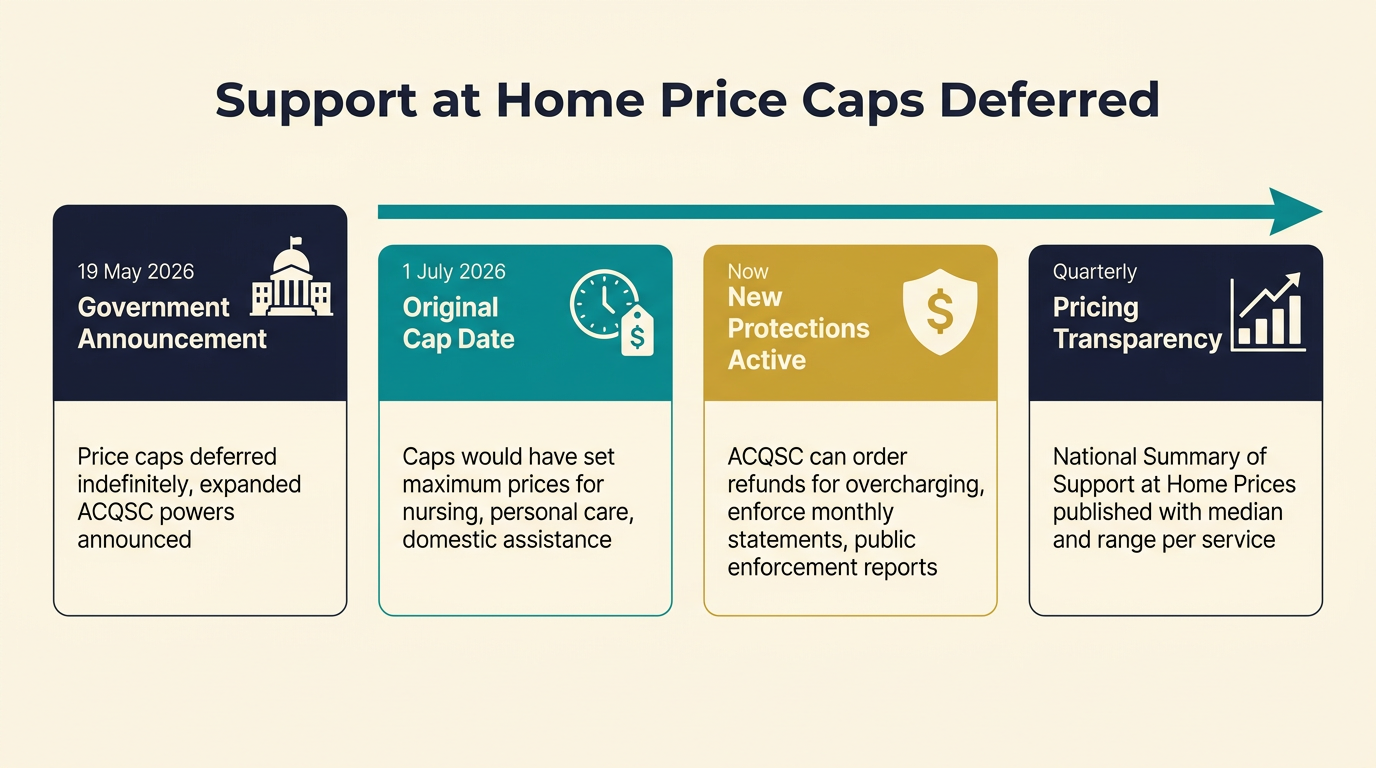
For more than a year, the Australian aged care sector has been preparing for price caps under the new Support at Home program. Providers modelled their pricing against the indicative rates the Department of Health and Aged Care published in 2024 and 2025. Software vendors built pricing modules against the expected caps. Care managers briefed consumers that maximum prices for personal care, nursing, and domestic assistance would take effect on 1 July 2026. That whole runway was torn up on 19 May 2026, when Health Minister Mark Butler and Aged Care Minister Sam Rae announced the price caps would be deferred indefinitely.
The caps are not gone. The Government has been explicit that the work on caps continues, and that the deferral is a response to current economic volatility rather than a policy reversal. But in their place, the Government has armed the Aged Care Quality and Safety Commission (ACQSC) with a new set of tools — most importantly, the power to order refunds for overcharging — and has introduced quarterly national pricing transparency reporting. For Support at Home providers, the compliance bar has not been lowered. It has been moved to a different axis.
This guide walks through what changed on 19 May, what the new ACQSC powers mean in practice, and what providers need to put on their compliance roadmap for the rest of 2026.
What was announced on 19 May 2026
The announcement came in a joint statement from Health Minister Mark Butler and Aged Care Minister Sam Rae. The core decision was that the Government will not proceed with the 1 July 2026 price caps for Support at Home services, and will not introduce formal caps until it has greater confidence in the stability of the sector. The Government acknowledged that setting caps during a period of economic volatility risked locking in inflated costs and producing poor outcomes for older people.
In place of the caps, the Government announced four consumer-protection measures to take effect immediately:
- Expanded ACQSC powers. The Commission can now order refunds where a provider is found to be overcharging, and take regulatory action — including enforceable undertakings and sanctions — against providers that fail to issue the required monthly statements.
- Quarterly price transparency reporting. A new National Summary of Support at Home Prices will be published quarterly, showing the median price and price range charged by providers for each service type. Older Australians and their families will be able to benchmark their provider against the national market.
- Focused monitoring of personal care pricing. The Department and the ACQSC will specifically monitor the price of personal care as it transitions into the Clinical Care category, building on the removal of out-of-pocket costs for showering, dressing, and continence services.
- Voluntary cap on price increase frequency. Providers are being encouraged to limit price increases to no more than twice per year, so that older people can plan and budget their packages with greater confidence.
A working group — comprising the Older Persons Advocacy Network (OPAN), COTA Australia, the ACQSC, and Ageing Australia — has been convened to focus on three priorities: a more robust definition of reasonable pricing, further consultation on the multi-provider model, and additional guidance for older people who self-manage their packages. The working group's output will inform the eventual cap design.
The new ACQSC refund power: what it means in practice
The headline change is the new power for the ACQSC to order refunds where a provider is found to be overcharging. This is a meaningful expansion of the regulator's toolkit. Until now, the ACQSC's response to pricing issues has been limited to compliance notices, enforceable undertakings, and sanctions against the provider's registration. Direct refund orders were not part of the regime.
The new power sits alongside the existing obligation to issue monthly statements. The monthly statement is the documentary foundation for the refund power: it is the record the ACQSC will examine when assessing whether a consumer has been overcharged. Providers that fail to issue monthly statements — or issue them late, incomplete, or with incorrect figures — will be subject to regulatory action independent of any overcharging finding.
In practice, the ACQSC has indicated it will work collaboratively with registered providers to resolve identified issues. The regulator's published position is that enforcement will be proportionate. But the Commission has also been clear that repeated or deliberate non-compliance may result in penalties or refund orders. The risk profile for pricing and statement compliance has shifted from "reportable incident" to "regulated activity with consumer restitution as a possible outcome."
Quarterly price transparency: how your pricing goes public
From the second half of 2026, the Department of Health and Aged Care will publish a National Summary of Support at Home Prices every quarter. The summary will display, for each service category, the median price and the range of prices charged by registered providers. Consumers, families, and advocates will be able to see exactly where your pricing sits relative to the market.
The implications for providers are significant:
- Pricing outliers will be visible. A provider charging meaningfully above the median for personal care will be obvious to consumers comparing services. This creates commercial pressure to align pricing with the market — independent of any regulatory finding.
- Justification becomes a documentation requirement. If your pricing is above the median, you need a documented rationale (staffing mix, geographic cost, specialised services) that you can produce on demand. Without it, the ACQSC can open an enquiry on the basis of the published summary alone.
- Below-median pricing invites its own scrutiny. Providers pricing significantly below the median will be examined for sustainability and quality. Underpricing that compromises care quality is itself a Quality Standard concern.
- Price increases need a paper trail. With the voluntary twice-yearly cap on price increases, the ACQSC will look at the history of your increases. A pattern of more than two increases per year, without a documented reason, is a flag.
What providers need to change in the next 90 days
The deferral of the caps is good news for providers who were concerned about margin compression. The new ACQSC powers are correspondingly more demanding. The following items should be on every provider's compliance roadmap for the remainder of 2026.
- Audit your monthly statement process end-to-end. Confirm that every consumer on every active package receives a statement every month, that the figures reconcile to the care plan and the unspent funds balance, and that statements are issued within the timeframe the Department specifies. Late, missing, or incorrect statements are now the most likely trigger for an ACQSC enquiry.
- Document the rationale for every price you charge. For each service category, capture the cost basis (labour, travel, materials, overhead) and the market position (median, quartile) in a single pricing register. This is the document you will produce if the ACQSC asks why a price is above the published median.
- Lock the cadence of price increases. Adopt a written policy that prices are reviewed no more than twice per year, with the next review date and the reasons for any increase recorded. Even though the twice-yearly cap is voluntary, documented adherence to it is now a defensible position.
- Build a refund-readiness workflow. When the ACQSC opens an enquiry, the first thing it will ask for is the consumer's pricing history, the monthly statements, and the documented basis for the price. Have a single workflow that produces this evidence pack within 48 hours, for any consumer, for any period.
- Train frontline staff on the new triggers. Personal care workers and clinical staff do not set prices, but they field questions from consumers and families about pricing changes. Brief them on the new ACQSC powers, the existence of the quarterly summary, and the escalation path for any consumer who believes they have been overcharged.
- Review contracts with third-party and sub-contracted providers. If you deliver Support at Home through subcontracted providers, the ACQSC refund power extends to you as the registered provider. Ensure your contracts give you visibility of sub-contractor pricing and the right to recover overcharges from the sub-contractor.
How NovoCove handles price transparency and refund readiness
NovoCove is built around the documentary foundation the ACQSC will examine. For Support at Home providers, the platform gives you:
- A monthly statement workflow that never misses a consumer. The platform reconciles unspent funds, service delivery, and pricing for every active package, and produces a statement ready for consumer delivery. Statements are timestamped and stored against the consumer record for the full retention period.
- A pricing register linked to evidence. Each price in the register is linked to its cost basis, its market position, the date of last review, and the rationale for any change. When the ACQSC asks for the basis of a price, the evidence is one click away.
- Refund-readiness evidence packs. For any consumer, for any period, NovoCove assembles the full pricing history, monthly statement archive, care plan reference, and the documented rationale. A 48-hour enquiry response becomes a 10-minute report export.
- Price increase cadence tracking. The platform enforces your twice-yearly cap policy, blocks unscheduled increases, and produces a clean audit trail of every change. The voluntary cap becomes a documented, auditable standard.
- Quarterly transparency summary alignment. When the Department publishes the National Summary of Support at Home Prices, NovoCove benchmarks your pricing against the published median and range, and flags outliers before the regulator does.
- Sub-contractor pricing visibility. For providers delivering Support at Home through subcontracted arrangements, the platform tracks sub-contractor pricing and flags any divergence from your own pricing register.
The deferral of the price caps is not a reprieve. It is a reframe. The compliance bar for Support at Home pricing has moved from "stay below the line" to "be ready to defend the line you drew." Providers who invest in the documentary foundation now will be ready when the caps eventually land — and will be defensible against the ACQSC refund orders and public enforcement reports in the meantime.
This guide is general information and is not legal advice.