Regulatory update
The Federal Childcare Enforcement Action Register: What 216 Sanctions in 11 Months Means for Every ECEC Provider
On 17 June 2026, the Australian Government Department of Education updated its public Enforcement Action Register for the first time since late 2025. The register now lists 216 ECEC services sanctioned under Family Assistance Law over 11 months — including suspensions, cancellations, infringement notices and conditions on Child Care Subsidy approvals. Here is what every Australian childcare provider should know about the register, the five sanctions it can publish, and the 30-day health check that keeps your service off it.
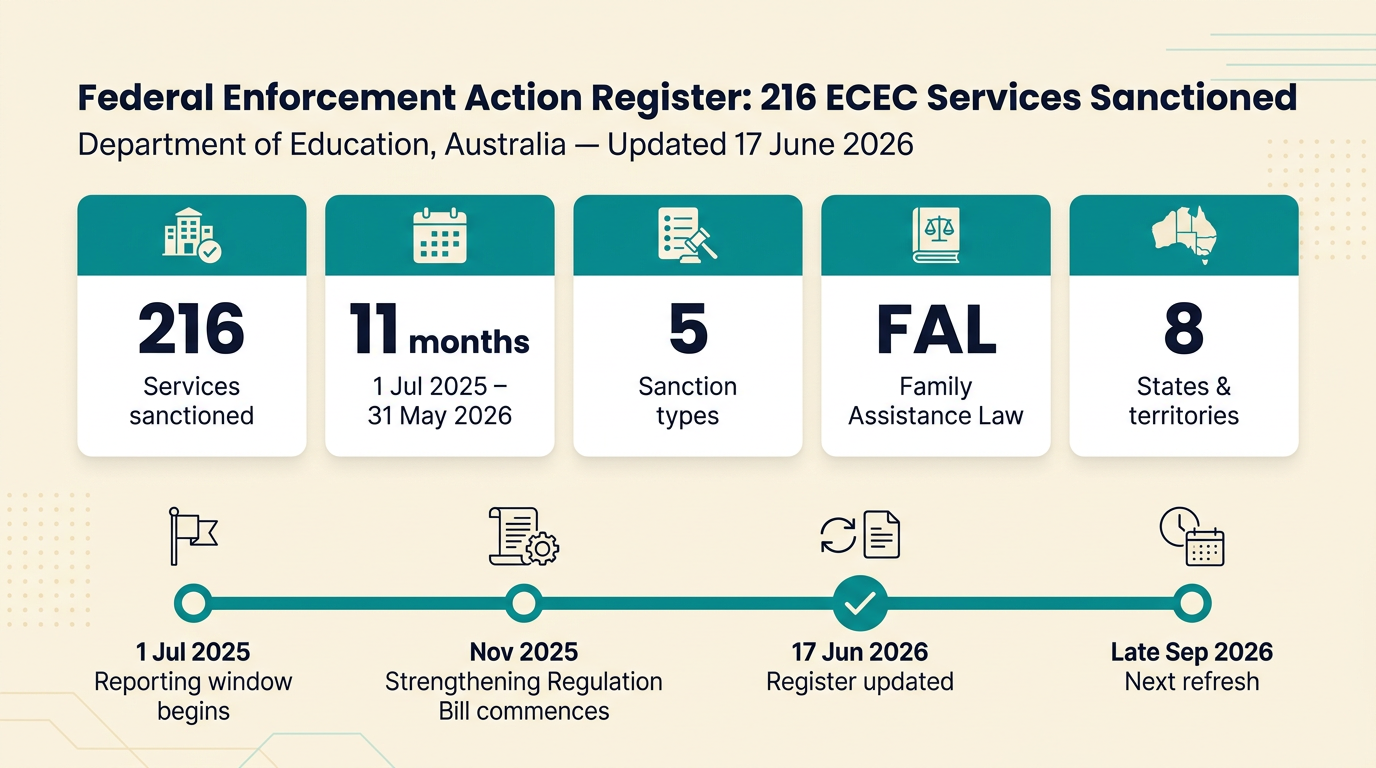
On 17 June 2026, the Australian Government Department of Education quietly updated its public Enforcement Action Register. For the first time, the register covers a full 11-month reporting window (1 July 2025 to 31 May 2026) and lists 216 early childhood education and care (ECEC) services that have been sanctioned for non-compliance with Family Assistance Law (FAL). That is more than the previous four reporting updates combined, and it lands in the same fortnight as the federal government published its new de-identified Infringement Notices Register. For every Australian childcare provider, this is the most visible evidence yet that the federal compliance regime is no longer a paper exercise — it is being enforced, named and published, and the publication is permanent.
What the Enforcement Action Register actually is
The Enforcement Action Register is the public, named-service record of every enforcement action the Department of Education has taken against ECEC providers and services for failing to meet their FAL obligations. The Department administers FAL — the law that governs Child Care Subsidy (CCS) approvals, gap fee collection, record-keeping, the statement of entitlement and the conditions of provider and service approval. FAL runs in parallel to, but is legally distinct from, the Education and Care Services National Law and Regulations that state regulators enforce on quality, supervision and educator ratios.
The register is published under section 219ZS of the A New Tax System (Family Assistance) Act 1999 and the strengthened disclosure framework inserted by the Early Childhood Education and Care (Strengthening Regulation of Early Education) Bill 2025. The Department first published a register in July 2025 and has refreshed it on a roughly quarterly cadence since. The 17 June 2026 update is the largest refresh to date.
What the 17 June 2026 update actually reveals
The register lists 216 ECEC services sanctioned between 1 July 2025 and 31 May 2026. The published entries include service names, provider names, the date the action took effect, the action type, and the relevant FAL provision. While the Department does not publish a public dashboard of the action-type breakdown, the published entries cluster around five sanction categories that every ECEC operator should read in detail.
Three patterns stand out from the 17 June update. First, section 197AB suspensions — immediate stop-payment orders on CCS while an investigation is underway — account for the largest single category of action. Second, infringement notices (financial penalties without court) are now being issued in volume, with the new Infringement Notices Register listing dozens of recent notices for record-keeping, statement-of-entitlement and gap fee breaches. Third, the conditions on approval category — where a provider is allowed to keep receiving CCS only if it complies with a remediation plan — has grown sharply, suggesting the Department is using these as a tool for ongoing oversight rather than one-off punishment.
The five sanctions that can land your service on the register
Under FAL and the Strengthening Regulation framework, the Department can apply any of the following five enforcement actions. Each one is publishable, and each one stays on the register until the action is formally revoked.
- Suspension of CCS approval (section 197AB). The most serious immediate action. CCS payments stop from a specified date while the Department investigates. A suspension can be applied without notice and can last up to 12 months. Families enrolled at the affected service can continue to attend, but the provider bears 100 per cent of the fee shortfall — making a suspension financially fatal for most services within weeks.
- Cancellation of provider or service approval. The nuclear option. Cancellation ends the provider's or service's ability to receive CCS in perpetuity, and triggers automatic notification to state regulators and ACECQA. Cancellation is reserved for the most serious or repeated breaches.
- Infringement notice. A financial penalty issued without going to court. The new Infringement Notices Register (also published 17 June 2026) records every notice issued, including the FAL provision breached and the penalty applied. Provider names are de-identified in the Infringement Notices Register but the underlying breach type is fully visible.
- Conditions on provider or service approval. The provider remains approved to receive CCS but must comply with stated conditions (for example, monthly reporting, mandatory external audit, capped enrolments). Failure to meet the conditions converts automatically into a suspension.
- Criminal conviction. For the most serious FAL offences (fraud, systematic over-claiming, falsified attendance records), the Department can pursue criminal prosecution through the Commonwealth Director of Public Prosecutions. Convictions are published on the register and result in automatic cancellation of approval.
Why the register went public — the policy backdrop
The register is the operational arm of a broader 2025–26 legislative push to make quality and safety the paramount consideration in CCS approvals. The Strengthening Regulation of Early Education Bill 2025, which commenced progressive rollout from late 2025 and into 2026, expanded the Department's powers to suspend or cancel CCS approvals for providers failing the National Quality Framework (NQF), and introduced unannounced compliance checks and gap fee collection enforcement. The public register is the transparency mechanism that makes those new powers visible to families, sector peers and the media.
That policy backdrop matters because the register is not a one-off publication — it is a standing compliance tool. Any provider that comes onto the register now will stay there for the life of the entry, and the next refresh (expected late September 2026) will include any enforcement actions taken between 1 June and 31 August 2026.
State registers are running in parallel
The federal register is not the only published list ECEC operators need to watch. State regulators maintain their own registers of enforcement actions under the National Law, and several were updated on the same day or in the same week as the federal release.
- Queensland's Register of Published Enforcement Actions was most recently updated on 8 June 2026 and lists suspensions of service approval and fines, including individual cases with penalties above $20,000.
- NSW's Register of Published Enforcement Actions publishes quarterly entries for FY 2025-26, including involuntary suspensions and cancellations of provider or service approval.
- Western Australia's Enforcement Actions collection was also last updated on 17 June 2026, listing suspensions and cancellations under the National Law.
A provider can find itself on multiple registers simultaneously — federal for an FAL breach, state for a National Law breach, ACECQA for an NQS rating action — and the registers cross-link in practice, with state regulators and ACECQA treating a federal enforcement action as a serious signal when assessing the service at the next assessment and rating visit.
The 30-day compliance health check that keeps you off the register
Most of the breaches that appear on the 17 June register are operational failures, not headline-quality collapses. They are record-keeping lapses, missing signed attendance records, late issue of statements of entitlement, or unrectified conditions on approval. The good news is that these are exactly the breaches a structured 30-day compliance health check can catch and fix before the Department does.
- Days 1–5: Reconcile your attendance evidence. Pull every CCS session claimed in the last 90 days and match it against signed attendance records. Any gap — even one missing signature — is a record-keeping breach under FAL and an infringement notice candidate.
- Days 6–10: Reissue every missing statement of entitlement. Under FAL, families are entitled to a statement within seven days of care being provided. Run a report of every session where the statement was issued late and reissue, with a written internal note on why the gap occurred.
- Days 11–15: Audit your conditions on approval. If your service has conditions on its approval (a remediation plan, a reporting cadence, a capped enrolment), confirm every condition has been met on time for the last six months. Any missed condition is an automatic suspension trigger.
- Days 16–20: Cross-check the NQS and the National Law. Open your most recent ACECQA assessment and rating report and identify every "not met" finding. For each, confirm you have remediation evidence that the state regulator can verify. A sustained "not met" rating is the single biggest predictor of a state-regulator referral to the Department.
- Days 21–25: Validate worker screening. Confirm every educator, volunteer, and student on site has a current WWCC and any required teacher registration, and that the National Early Childhood Worker Register entry is current (the 14-day update rule still applies).
- Days 26–30: Lock the evidence pack. Bundle the outputs of the first five phases into a single evidence pack with a timestamp, a sign-off from the approved provider, and a clear cross-reference between each FAL obligation and the artefact that proves compliance.
How NovoCove tracks this for you
NovoCove is built around the exact evidence chain the Department is now asking for. Every educator record, every WWCC, every mandatory training module, every policy version and every CCS session is timestamped, version-controlled, and exportable into a single evidence pack that maps directly to the obligations on the federal Enforcement Action Register.
The compliance dashboard surfaces the conditions on your approval as live tasks with deadlines, not buried PDF attachments. The audit log captures every change to an evidence item, so when the Department asks "show me the version of this policy that was current on 14 March 2026", NovoCove produces the answer in one click. And the audit pack export follows the same evidence categories the Department's own Provider Tool Kit recommends — so the document the regulator sees is the document your team already uses.
The 17 June register is a warning that FAL compliance has become a published, permanent, and operationally consequential discipline. The providers who stay off the register in 2026 are the ones who treat compliance evidence as a living system, not a once-a-year audit exercise. That is the system NovoCove is designed to run.
This guide is general information and is not legal advice.