Aged care funding & viability
AN-ACC Price Increase 1 October 2026: $303.19 Per Resident Per Day, a Frozen Hotelling Supplement, and the Real-Terms Squeeze on Residential Aged Care
From 1 October 2026 the AN-ACC price rises 2.55% from $295.64 to $303.19 per resident per day, lifting estimated average funding from $317 to $325 per resident per day — an increase the Department of Health, Disability and Ageing says explicitly folds in the 4.75% Annual Wage Review decision, the gender undervaluation case and the aged care work value case. The hotelling supplement stays frozen at $22.15 per resident per day pending an IHACPA review that is not expected to report until December 2027. Care minutes targets, AN-ACC Base Care Tariffs and classification weightings are unchanged. Providers — 62% of residential homes already operating at a loss, per StewartBrown — say a 2.55% rise against 3.5% inflation is a real-terms cut that will shelve new beds and hit rural and remote areas hardest. Here is what changed, what the new price actually funds, and the six budget actions for residential aged care providers.
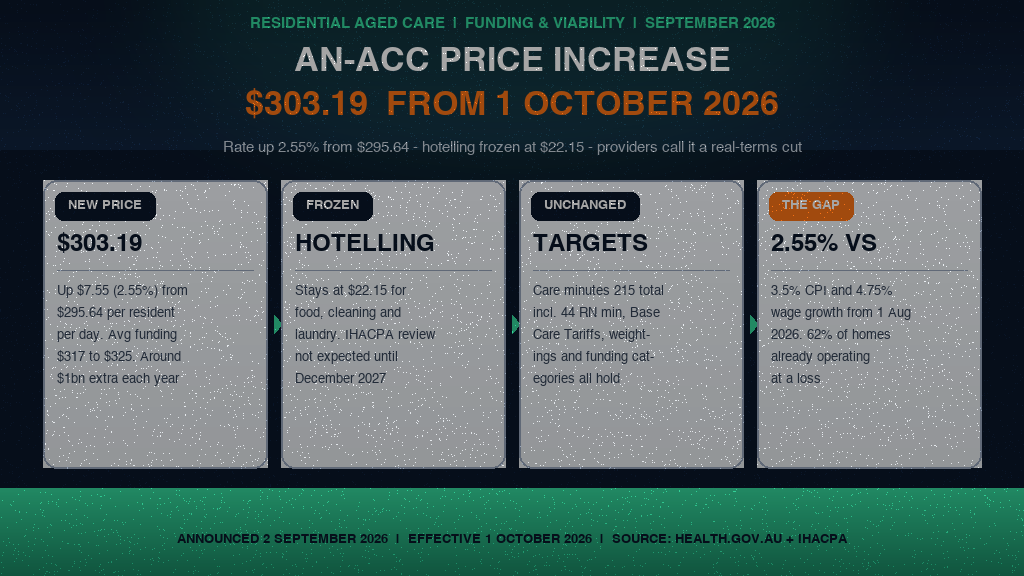
From 1 October 2026, the Australian National Aged Care Classification (AN-ACC) price — the daily amount the Commonwealth pays towards each residential resident's care — rises 2.55% from $295.64 to $303.19 per resident per day. It is the first annual price change the Government says explicitly prices in the 4.75% Annual Wage Review decision, the gender undervaluation case and the aged care work value case that have been flowing into payrolls since August. But the same announcement froze the hotelling supplement at $22.15 per resident per day, left care minutes targets untouched, and handed providers less than a month's notice — while inflation sits at 3.5% and peak bodies call the outcome a real-terms cut.
Background: how residential aged care funding is priced
Residential aged care funding runs on two rails. The first is the AN-ACC, which replaced the old ACFI system from October 2022: every resident is classified into one of 13 AN-ACC classes according to their assessed care needs, and each class carries fixed and variable funding components that are multiplied by a single national AN-ACC price — the dollar amount per resident per day that is meant to fund the care itself. The second rail is a family of supplements for costs outside the classification: the hotelling supplement for everyday living costs such as food, cleaning, laundry and energy (raised 42% last year to its current $22.15), the care minutes supplement for homes meeting their minute targets, and others. Accommodation is funded separately through means-tested accommodation payments, not the AN-ACC.
The price is set annually on advice from the Independent Health and Aged Care Pricing Authority (IHACPA), which cost-collects from providers to model what care actually costs to deliver. When the AN-ACC price was introduced in December 2023, the Government committed to announcing each year's adjustment in August, giving providers two months of notice before the new rate took effect on 1 October. That cadence matters because the price is the difference between planning and scrambling: providers set resident fees, staffing profiles and budgets against the funded rate.
That commitment has now been missed two years in a row. The current $295.64 price was announced late in 2025 for 1 October 2025, and the 2026-27 price — announced on 2 September 2026 — again landed with under a month to go. The timing is not cosmetic: the sector enters the 2026-27 year with the 4.75% Annual Wage Review increase and the aged care work value case outcomes already in its cost base (from 1 August 2026), inflation at 3.5%, and StewartBrown's latest financial report showing 62% of residential aged care homes operating at a loss. Average per-resident-per-day care funding has grown around 65% since September 2022 — but so, providers argue, has the gap between what care costs and what the price funds.
What changed and when: the 2 September 2026 announcement
On 2 September 2026 the Department of Health, Disability and Ageing published its residential aged care funding update and the Minister for Aged Care and Seniors, Sam Rae, announced the 2026-27 price. The details that matter for every residential provider:
- The AN-ACC price rises to $303.19 per resident per day from 1 October 2026. That is an increase of $7.55 (2.55%) on the current $295.64. Estimated average funding rises from $317 to $325 per resident per day, and the Government says the increase adds around $1 billion a year to aged care expenditure for more than 200,000 older people in residential care.
- The increase is priced on IHACPA's 2026-27 advice and explicitly includes the wage cases. The department lists four components inside the rise: the 4.75% Annual Wage Review decision for 2026, the gender undervaluation case, the aged care work value case, and non-labour cost growth. This is the first annual price built after those wage outcomes — a direct funding line to the pay rises that commenced on 1 August 2026.
- The hotelling supplement stays frozen at $22.15 per resident per day. The rate that funds food, cleaning, laundry and energy is unchanged for the second year in a row, consistent with IHACPA's pricing advice. IHACPA is reviewing everyday living expenses at the Government's request, but that review is not expected to report until December 2027 — any change to the supplement will wait on it.
- Care minutes, tariffs and weightings are all unchanged. The department confirms no changes to care minutes requirements, AN-ACC Base Care Tariffs, classification weightings, or the fixed and variable funding categories. The staffing obligations already in force — the 215-minute average including 44 registered nurse minutes, and 24/7 RN coverage — keep running on the same funded settings.
- The announcement came with less than a month's notice, again. The August-announcement commitment was missed for the second consecutive year. Providers had under four weeks between the 2 September announcement and the 1 October effective date to reflect the new price in budgets.
- The Government's framing: $47 billion and 5,000 new beds a year. Minister Rae said the increase means "more funding for aged care homes, supporting workers and better care for our loved ones", pointing to $47 billion in aged care investment this year including a $1.7 billion 2026-27 Budget commitment to support construction of 5,000 additional beds a year through new incentives. Sector leaders responded that the numbers do not reconcile with the costs in front of them.
The sector's arithmetic is straightforward and unfavourable. Anglicare Sydney chief executive Simon Miller called the increase "a cut in everything but name", noting wages climbing 4.75% and costs rising faster than funding; Ageing Australia CEO Tom Symondson described a "real terms cut" with CPI at 3.5%; Catholic Health Australia's Alex Lynch called it a "significant real-terms funding cut" that jeopardises access to care at a time when many providers are already making operating losses; and Bolton Clarke's Olivier Chretien pointed to the IHACPA mandate to reduce provider margins on care to zero — "no room for error in IHACPA's methodology", with award wages up 4.75% and inflation at 3.5% against a 2.55% increase. Ageing Australia says "numerous" CEOs are shelving projects as a result, with new beds that would have been built now on hold, and the impact falling hardest on rural and remote areas.
Operational impact: six things every residential provider should do now
The price decision is made; the planning response is yours. Six actions for every residential aged care provider between now and the end of the year:
- Re-forecast every home's funding at $303.19 and measure the gap to your real cost base. The uplift is mechanical: $7.55 per occupied bed per day from 1 October, roughly $275,575 a year at 100 occupied beds (or $165,345 at 60 beds) before supplements, classification mix and occupancy risk. Model it site by site against actual care costs — not against last year's budget — and quantify the residual gap per resident per day that wages, agency costs and non-labour inflation have opened since August.
- Price the wage-cost timing mismatch into cash flow. The 4.75% Annual Wage Review increase and the work value case outcomes hit payrolls from 1 August 2026 — two months before the AN-ACC uplift starts and months before the historical leave liabilities grant (GO8512) reimburses a share of past leave-cost increases. Providers that did not pre-fund the August-to-October bridge need a cash position check now, including the 25% or 50% grant claims still open until 2pm AEDT 6 October 2026.
- Stress-test every capital decision against the frozen hotelling rate. Everyday living costs — food, cleaning, laundry, energy — are the costs growing fastest in an inflationary year, and the $22.15 supplement funding them is frozen until at least the IHACPA review reports in December 2027. New builds, refurbishments and service expansions should carry a downside case at today's funding settings, because that is the setting that will be in force for the life of the current pipeline.
- Keep the everyday-living-cost evidence trail anyway. The IHACPA hotelling review will set the next supplement rate, and it will be built on provider cost data. Homes that document actual food, cleaning, laundry and energy costs per resident per day now — invoices, menus, service contracts, utility bills — are positioning for a future recalculation; homes with no trail will have no voice in it.
- Protect care minutes delivery — the funding categories did not move. Care minutes requirements, Base Care Tariffs and classification weightings are unchanged, which means the compliance settings are unchanged too: the 215-minute target including 44 RN minutes, 24/7 RN coverage, and the first externally audited Care Minutes Performance Statement due with the 2025-26 ACFR on 31 October 2026. A provider responding to the funding squeeze by trimming below target forfeits the care minutes supplement and exposes itself to audit findings and regulatory action — the most expensive possible response to a 2.55% price rise.
- Run the prudential and reporting check before year-end. With 62% of homes loss-making, the Aged Care Quality and Safety Commission's Financial and Prudential Standards are squarely in play: liquidity reporting, prudent financial management and accurate Quarterly Financial Reports. Lock the new price into QFR and ACFR planning so the funding uplift, the supplement positions and the audited care minutes statement all tell one story.
A 30-day workflow to reset the budget on the new price
Working from the announcement on 2 September, this workflow lands a re-forecast before the new price takes effect on 1 October, with evidence intact for the December reporting cycle:
- Days 1-5 — Recast funding at the site level. Apply $303.19 per occupied bed per day to each home from 1 October, overlay your classification mix, supplements (hotelling at $22.15, care minutes, other program-specific supplements) and realistic occupancy, and produce a full-year funding line per site. Flag every home whose uplift does not cover its known cost increases.
- Days 6-12 — Quantify the wage and cost gap with finance. Pull the actual payroll impact of the 4.75% AWR increase and work value outcomes since 1 August, split by direct care and non-direct care, and compare it with the AN-ACC uplift by month. Add agency, food, energy and clinical supply inflation. The output is one number: the residual gap per resident per day your home must close through efficiency, not through care cuts.
- Days 13-19 — Review the levers that are actually available. Re-tender non-care contracts, review agency usage against permanent staffing mix, check roster efficiency against care minutes targets (without breaching them), and validate every resident's AN-ACC classification is current — reclassifications are the one funding lever inside your control, and the window to review them is open now, not in a funding crisis.
- Days 20-26 — Stress-test capital and service plans. Re-run any new-bed, refurbishment or service expansion business case at today's funding settings, including the frozen hotelling rate through December 2027. Confirm which projects still clear hurdle rates, which are deferred, and document the reasoning for the board — deferral decisions made deliberately beat projects quietly dying.
- Days 27-31 — Close the loop on reporting and governance. Update the QFR and ACFR planning calendar with the new price and supplement positions, confirm the care minutes supplement strategy against the 31 October CMPS audit timeline, check the GO8512 grant deadline (2pm AEDT 6 October 2026) if historical leave liabilities apply, and take the residual-gap and capital decisions to the board with a single evidence pack.
How NovoCove supports this
A funding reset is, underneath the finance work, an evidence exercise: which credentialed staff are in your cost base, which obligations their registrations support, and what records you can produce when the price, the prudential standards and the care minutes audit all converge on the same quarter. NovoCove is the data and evidence layer behind that exercise — it centralises staff certifications and training expiry for aged care providers, including AHPRA registration for registered and enrolled nurses, NDIS Worker Screening and more, with automatic alerts from expiry windows and a RAG status per service, so a registration lapse that could compromise an RN care minute is flagged weeks ahead rather than discovered by an auditor.
That workforce register is the same data the funding obligations lean on: care minutes only count when delivered by currently registered, eligible staff, and the 24/7 RN requirement only holds when the roster evidence proves it. NovoCove keeps that evidence current, organised and exportable — one register leadership can hand to finance for the re-forecast, to the board for the capital decision, and to the auditor for the CMPS engagement. Daily ComplianceSnapshot trend and audit logging give the plan a defensible record as the six actions above move from a list to a completed program.
NovoCove does not replace your payroll, rostering or general ledger systems, and it is not financial advice: pricing decisions, wage modelling, classification review and capital planning stay with your finance team and advisers. It does not generate or lodge funding claims, and it is not involved in setting the AN-ACC price or the hotelling supplement. What it does is keep the workforce data layer those decisions sit on current — the same data any provider needs to answer "who was eligible, on which shift, with which current registration" the moment the question is asked. The coverage is detailed on the aged care compliance software page.
Book a 20-minute demo and we will show you what a residential workforce register looks like when every AHPRA registration and training expiry has an owner and an alert cadence — before the new price and the reporting season land together.
Sources / further reading
- Residential Aged Care funding update (2 September 2026) — Department of Health, Disability and Ageing (T1)
- Supporting better quality residential aged care — Minister for Aged Care and Seniors media release (2 September 2026) — Department of Health, Disability and Ageing (T1)
- IHACPA residential aged care pricing advice 2026-27 — Independent Health and Aged Care Pricing Authority (T1)
- AN-ACC funding rises 2.55% but providers warn increase falls short of costs — Inside Ageing, 2 September 2026 (T2)
- Providers say AN-ACC 'cut' will affect services, new builds — Australian Ageing Agenda (T2)
- StewartBrown residential care financial performance survey (62% of homes loss-making) — via Australian Ageing Agenda (T3)
This guide is general information and is not legal advice.